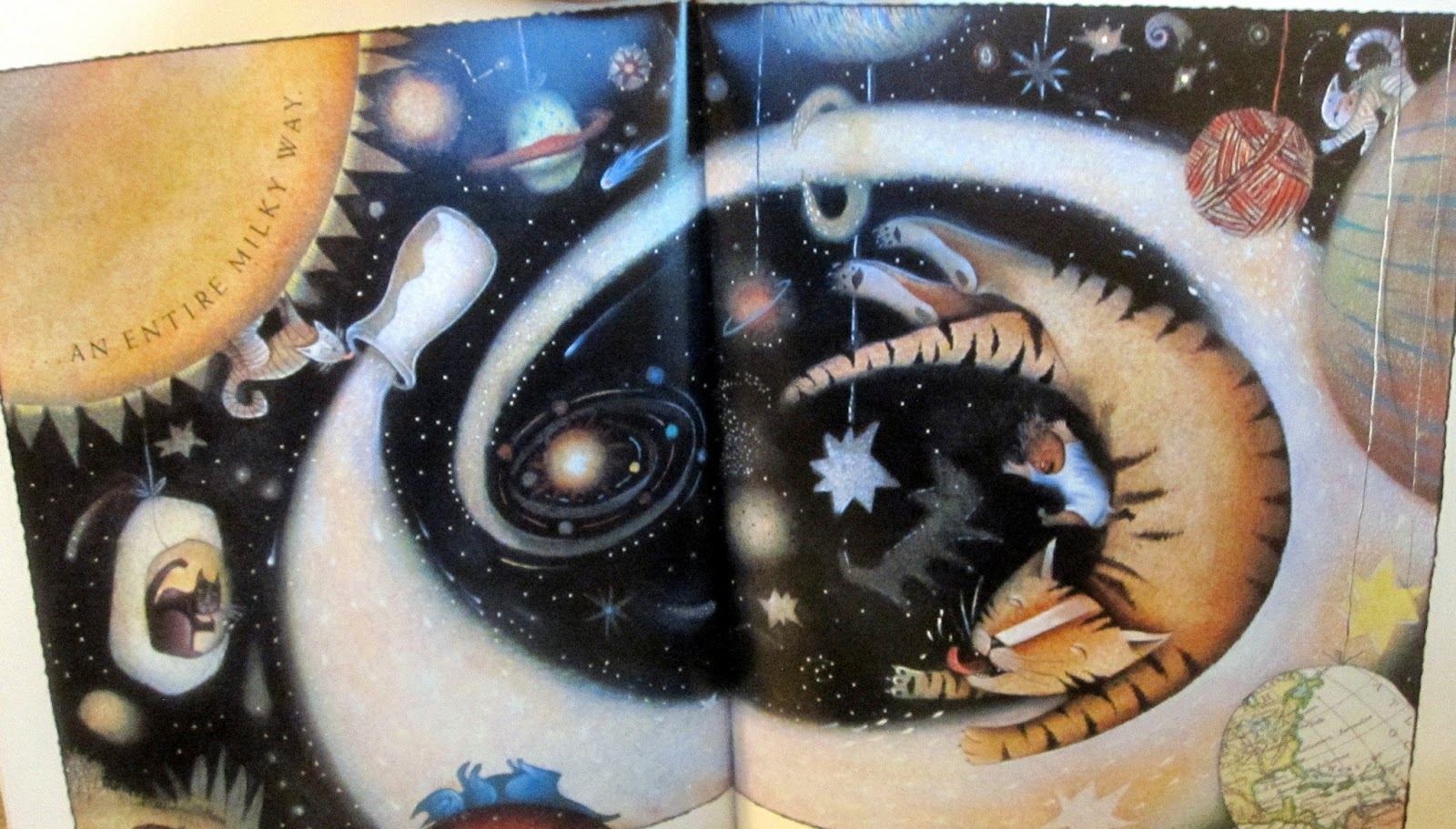
The thing I like the most about children's stories (aside from the fact that they're chock full of magic and wonder) is the way they can make it possible to take a leap from your living room chair into the whole of the universe.
Take Diary of a Worm by Doreen Cronin, for example.
On the first page, it introduces the idea that the world is much bigger than just us. Then it goes on to talk about the specifics of our world... from the perspective of a worm, but in the context of something much larger.
Simple, but effective.
Or take this book:
Tuesday opens up the idea that everything is weirder than you can imagine...
...that anything is possible...
...and that you can never predict tomorrow. In addition, there aren't any words in the book, so it allows you to tell the story yourself.
The Magic School Bus uses facts. It says "look how amazing the universe is. For real!"
...except for the whole "magic" part...
If you check out Baloney (Henry P.) by Jon Scieszka and Lane Smith, it takes the total opposite approach - take a look at the immense potential for exploration that is available just inside your own mind.
Also it has fantastic pictures.
But my favourite of all has to be The Big Pets by Lane Smith. First of all, the illustrations are spectacular (you may notice that the images are oddly similar to the illustrations in Baloney)...
...and secondly, it takes you from simple, wonderful, and calm imaginary place where the girl is small and the cat is big...
...to the massive majesty and awe of the universe in one two-page spread. I could stare at this page all day.
...with the milk and the cat and cat toys and the stars
and the globe in the corner there and the yarn
and the little cat houses
and all of the cats!
Children's stories are great, and if you keep looking and reading, you'll find the perfect one: a story that opens up the whole of the universe just for you in just a few short pages.
To check out more blogs about children's literature, visit the Genre Underground.
In Stargate Universe, there is a hydroponics lab (see right). What is hydroponics? you ask.
Hydroponics is a method of growing plants without soil. Simply put, the necessary nutrients for growth are put in water, and the roots absorbs them without ever touching soil. The Stargate version has the plants growing towards a centralized light source while spinning slowly and watering the roots at the base (which you can see in the image). The water is of course filled with the necessary nutrients. You can find more information on this system here.
The Boston Fern is
named Franklin.
He's cute.
I have more recently been interested in plants, especially the live kind that grow (as opposed to the dead kind that don't). My new(ish) apartment actually gets light during the day, so I have found warm and wonderful spots for my plants. Here they all are in a row, happily out of the snow (left).
When I no longer have an apartment and am also not living with relatives or in a van (this assumes that I can afford a house at some point in my future), I would like to build a hydroponic garden. I have to get to it before the hipsters, though. My other option (if the whole house thing falls through) is to build an ecosystem in a bottle. I guess I could do that anyway. Look at this guy. He appears incredibly happy. I imagine I would also be happy if I had an entire ecosystem that I could hug.
David Latimer, hugging an entire ecosystem. Photo credit.
Now, if I were to grow an entire ecosystem in a bottle, I would include fairies. In fact, maybe that's what genies are - fairies trapped in one ecosystem that is somehow contained inside a magic lamp. That is probably why genies are always grumpy - weeds are constantly taking over everything! If you don't believe me that genies are grumpy, read Arabian Nights.
At any rate, until I can afford a house and power tools, I guess I will have to stave off my impatience by growing real plants and doodling pictures of plants. Maybe some plants hanging off of walls, or plants stuck inside bottles (see image to right) or even plants that can fly! Plants that can live in outer space! Plants that are intelligent life forms!
And then, of course, I will share my plant pictures with you.
Discworld is awesome! It is one of my favourite places of all time. It goes like this...
"In a distant and second-hand set of dimensions, in an astral plane that was never meant to fly, the curling star-mists waver and part...
"See...
"Great A'Tuin the turtle comes, swimming slowly through the interstellar gulf, hydrogen frost on his ponderous limbs, his huge and ancient shell pocked with meteor craters. Through sea-sized eyes that are crusted with rheum and asteroid dust He stares fixedly at the Destination.
"In a brain bigger than a city, with geological slowness, He thinks only of the Weight.
"Most of the weight is of course accounted for by Berilia, Tubul, Great T'Phon and Jerakeen, the four giant elephants upon whose broad and star-tanned shoulders the disc of the World rests, garnlanded by the long waterfall at its vast circumference and domed by the baby-blue vault of Heaven.
"Astropsychology has been, as yet, unable to establish what they think about..."
-The Colour of Magic, by Terry Pratchett, the man
Terry Pratchett, a brilliantly eccentric gentleman of great writing prowess, created this fascinating and wonderful world - a disc which sits on top of four elephants which sits on a giant sea turtle which swims through space - it's brilliant. Just brilliant.
I hope to meet Terry Pratchett. Sooner than later, preferably.
If you think you know what cold is, you should go to Hoth. Antarctica has nothing on Hoth. Hoth is cold. Did I mention? Freezing! Ice, snow, more ice, more snow. It does have some pretty sweet animals, though. A tauntaun and a wampa.
The Rebel Alliance moved here, but a probe eventually discovered the base and then, naturally, Darth Vader showed up. I wonder if he could feel the cold. I know he's half robot, but there's some human skin in there somewhere. He probably has air conditioning inside his suit.
Hoth is the sixth planet in the Hoth system. It has three uninhabited moons. Aside from the Tauntaun and Wampa, there may also be lichen living in underground caves on this planet.
Hoth looks oddly similar to Uranus to me, but with a bit more detail. Also this is not a photograph.
In conclusion, if you don't like the cold, don't move here. Also, watch Star Wars.
Out of all of the animals in the universe, I happen to like cats. Cats are funny. I
am currently owned by only one cat, but have many other cats in my life. For example, Charles, who currently resides with my parents, looks like this:
Giant, orange, male, and very kingly, Charles also likes to drape his massive body over whatever warm surface he can find (usually a human), and lick toes (and fingers, and arms, and faces...).
Cats are terribly odd creatures. So what happens when you combine a cat with a peacock?
(This is George, he also lives at my parents' house).
This does:
And this:
I guess it's a good thing Charles isn't a bird-cat. Or else George would probably be lunch.
If the universe exploded into existence, it probably looked something like a firework. It probably made a loud noise, too and left trails of sulfur smoke trailing through the young vacuum of space.
If the universe exploded, and there was no one there to hear it, did it make a noise?
Of course, maybe it was backwards. Maybe it didn't explode into the dark, maybe it exploded into light. Maybe everything was made of light originally, then a virus in the system caused an explosion of dark matter... which is now winning... or something. If that were the case, it probably looked more like this:
Either way, I'd say it probably looked very cool.
Instead of looking at the history of the U.S. (today is the 4th of July, after all), let's take a look at the history of the universe.
At second 0, it popped into existence, in some way or another.
At second 10^-43 seconds, it was really hot. So hot, in fact, that electromagnetism, gravitation, weak nuclear interaction, and strong nuclear interaction were unified. Like a really awesome (and useful) super hero.
Between 10^-43 seconds and 10^-36 seconds the universe began to expand and cool. As it cooled, electromagnetism, gravitation, weak nuclear interaction, and strong nuclear interaction began to separate.
Between 10^-36 and 10^-12 seconds, the four forces separated.
Then, supersymmetry broke, and quark-gluon plasma filled the universe.
By 1 second, the quark gluon plasma had cooled to the point that hadrons formed. Neutrons began to decouple and travel freely through space.
At 10 seconds, the temperature had fallen. It was cold, like the North Pole--so cold, that new lepton and anti-lepton pairs ceased to be born. The reigning race slowly began to fade.
Between 10 seconds and 380,000 years, photons took violent control, carefully and thoroughly usurping the dying reign of the leptons. Their 380,000 year minus 10 seconds reign was primarily characterized by their rowdy interactions with charged protons, elections, and nuclei.
There were a couple of important events during the reign of the protons. For starters, the temperature fell at a rapid rate between 3 and 20 minutes. This allowed for atomic nuclei to form--ultimately resulting in nuclear fusion. This is important because it is by nuclear fusion that all matter is created. We are stardust, you know.
At 70,000 years, cold, dark matter began to dominate the space that is now the universe.
Jump to 377,000 years. The density of the universe fell, and hydrogen and helium atoms began to form. As the universe cooled, elements began to recombine, and by the end, photons traveled freely and the universe had become transparent.
Then over millions and billions years, small structures formed. Stars and quasars formed. Plasma became the universe's reigning race. Millions of stars began to form, and pushed forward the process of turning lighter elements into heavier elements. Clusters of stars formed, then superclusters, solar systems, and galaxies. Planets, asteroids, and black holes littered the space between stars.
People and animals exist on at least one small planet, and probably more.
The universe is probably about 13.75 billion years old. It will die, although not anytime soon. Most predict a Big Freeze, although others suggest a Big Crunch, a Big Rip, or being cooked, sometime in the next twenty billion years from now (or 100 billion or 10^14 billion--take your pick).
Either way, if you happen to be there, your best bet is to wear layers.
Today I am going to share with you a series of super cool pictures that you probably haven't seen before. I will also be kind, generous, and nice, and tell you what the picture is of, who is in it, and why I think it is cool.
This is Apollo 17 astronaut Ronald Evans. In this image, he is retrieving a film canister during a space walk. Now think for a minute about the evolution of photography. He is in space--in 1972. First of all, going to space is an amazing accomplishment. At this time, however, not only have we been in space, but we've been to the moon, orbited, done all kinds of crazy, amazing things. In fact, we still look to these guys as the heroes of modern space technology. But, he's retrieving a film canister. Now, film canisters are for art majors--we have digital everything. I find this an interesting juxtaposition between a technology which was far beyond it's time, and a technology that was right on time.
Below you will see Dr. Robert Goddard at Clark University in Worchester, MA. Year: 1924. This was long before space travel. Dr. Goddard taught physics. In 1920 he had a paper published by the Smithsonian Institution, wherein he asserted that rockets could be used to send payloads to the moon. Of course, you know the press--they mocked him and began calling him "Moon Man." Eventually, when rocket science became real, scientists began to realize that it was nearly impossible to build a rocket or launch a satellite without acknowledging Dr. Goddard.
I think we should probably start listening to physics professors more often.
This is Harrison Schmitt, astronaut from Apollo 17, collecting Lunar Rock samples. That is also a giant moon rock. It's too bad he couldn't get the entire thing. Or maybe he did...
At any rate, every time I look at this picture, I see that rock... and it's fantastic. December 14, 1972
This is James Irwin, saluting beside an American flag. Look at that giant space bug behind him. You know what has always awed me about their equipment? It looks like gold tinfoil. Their space vehicles aren't shiny and rock solid looking as scifi would have us believe. They're real. Every time I see them I am reminded that they're real.
This is the launch of the bumper V-2, a critical moment in the history of space travel. The bumper V-2 was the first ever rocket launch from Cape Canaveral. This two stage rocket (V-2 missile on the bottom with a WAC Corporal Rocket on the top) exploded from the ground, then detached from itself, and the top half could fly to nearly 400 kilometers, which is even higher than modern rockets can fly.
While you're thinking about that, look at those guys. Look at that equipment.It's incredible. It looks like equipment from the 1950s! Oh, did I mention? They sent this rocket up July 24, 1950. Amazing.
Below is the Lunar Prospector spacecraft on its way to the moon. I think that this picture is beautiful. You can't see the spacecraft, but you can see its tail and the Earth in the distance behind it. It's incredible. 1998.
This is a solar powered airplane. Amazing. It was tested in 2001. It looks so weird, like an alien space ship or something. No wonder people are always seeing UFOs. If I saw this, I would think aliens had landed, too.
This astronaut is floating in space. I want to float in space.
This astronaut is floating in space, having his picture taken next to Earth. I want to have my picture taken next to Earth. Instead, I will have to be satisfied with having my picture taken on Earth.
Below is a picture of the Eagle Nebula, also called the Pillars of Creation. This is one of my favourite nebulae; it is extremely photogenic, too. These pillars of dust are the birthplace of stars, although their star formation peaked several million years ago. The red represents low energy, the green represents medium energy, and the blue represents high energy.
I could stare at this all day.
This is Earth. This is where we live. This is the thing that provides us everything we could ever possibly need and then some. This is what keeps us safe, and quite warm, as you can see. This image is a false colour depiction of long wave heat escaping from Earth. If the heat didn't escape, the Earth would become as hot as the sun. It's beautiful. And it's ours.
Yesterday, my little brother called me from Texas to tell me that he was walking through a grove of grapefruit trees. I imagined the sun shining down on his broad shoulders as he carefully selected a warm, ripe grapefruit from the ground; around him, light cheerful breezes bumped gently into heads of grass, and rustled the leaves of these glorious trees...
I live in New England; we don't have grapefruit trees. We have a bit of snow, though. He sent me a picture:
When he called, I was sitting in front of my computer, working. In front of a screen. As I am doing right now. All my time is spent in front of screens. Working. Writing. Communicating.
When he hung up, I wrote a poem:
i told Dave i want to be a hermit
a hermit in outer space
where there are no screens
just stars and stuff
and the bits that make up the sky, the dark, grapefruit trees
and stuff
i want to be a space hermit
As you can see, I am not good at poetry. That is why I write in sentences. But I am a little jealous of my brother, strolling through a grove of grapefruit trees and picking up the fresh fruit, peeling back the skin, biting into the tangy, bitter, juicy bits of starlight before laying down in the gently swaying grasses to nap under a canopy of blue heavens and surrounded by the sweet scent of spring...
If I were a space hermit, I'd have a houseboat floating in the giant space ocean moored to an Earth-like island with a grove of sweet, ripe moons--some crimson red with swirls of lavender blue, dilly dilly, or sparkling green and cerulean blue and antique white that dallied in the blossoming dawn. I'd have a fossil museum in my living room, with bones as large as Mount Everest glistening in a heap near the swirling asteroid zephyrs that whirl and spin a path through a wilderness of stars.
But if you came to look for me, I'd be hard to find; I'd be too busy painting the tiny motes of dust that drift through the starlight streaming through my stained-glass curtains, or surfing on the massive and rolling gravitational waves that soar through the darkness of space and time and crash against planets and stars and the sands of time... and there would be no screens, just everything.