Showing posts with label space. Show all posts

Thursday, May 16, 2013

Leaping Into the Universe - Children's Literature Week

The thing I like the most about children's stories (aside from the fact that they're chock full of magic and wonder) is the way they can make it possible to take a leap from your living room chair into the whole of the universe.

Take Diary of a Worm by Doreen Cronin, for example.


On the first page, it introduces the idea that the world is much bigger than just us. Then it goes on to talk about the specifics of our world... from the perspective of a worm, but in the context of something much larger.


Simple, but effective.

Or take this book: 


Tuesday opens up the idea that everything is weirder than you can imagine...


...that anything is possible...

...and that you can never predict tomorrow. In addition, there aren't any words in the book, so it allows you to tell the story yourself.

The Magic School Bus uses facts. It says "look how amazing the universe is. For real!"


...except for the whole "magic" part...


If you check out Baloney (Henry P.) by Jon Scieszka and Lane Smith, it takes the total opposite approach - take a look at the immense potential for exploration that is available just inside your own mind.


Also it has fantastic pictures.


But my favourite of all has to be The Big Pets by Lane Smith. First of all, the illustrations are spectacular (you may notice that the images are oddly similar to the illustrations in Baloney)... 


...and secondly, it takes you from simple, wonderful, and calm imaginary place where the girl is small and the cat is big...


...to the massive majesty and awe of the universe in one two-page spread. I could stare at this page all day.
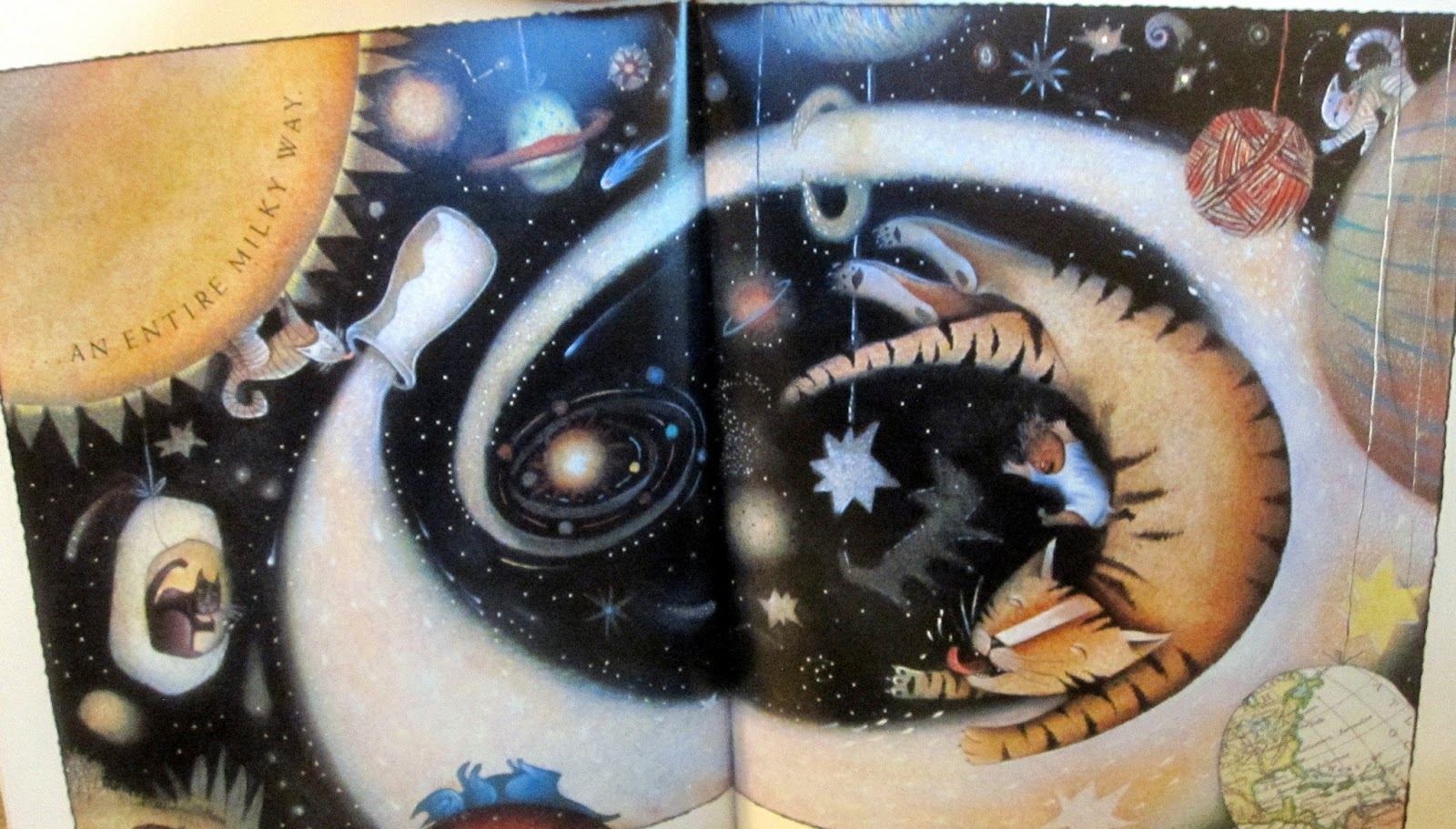
...with the milk and the cat and cat toys and the stars
and the globe in the corner there and the yarn
and the little cat houses
and all of the cats!

Children's stories are great, and if you keep looking and reading, you'll find the perfect one: a story that opens up the whole of the universe just for you in just a few short pages.


To check out more blogs about children's literature, visit the Genre Underground.


Wednesday, December 12, 2012

Meteor Showers Hurt

Apparently there is a meteor shower going on tonight. I think meteor showers are very interesting things. Some people envision this:


...brilliant streams of light sparkling in the  night sky - glittering wishes, hopeful, but sad and quickly gone.

Then NASA shows us pictures like this


...an underwhelming streak of light about to disappear in the overwhelming beauty of our planet.

I have a slightly different image: an image of giant rocks soaring through millions of light years of space, only to accidentally bump into a planet and begin plummeting to their doom, ablaze; miles of atmosphere, of cold, and hot and fire... and then they drop on my head with a perpetual clatter as I try to slather shampoo into my hair. And of course they melt the plastic on the bottom of my tub and I don't get my deposit back when I move out of my apartment. 

You know what I think about meteor showers? They hurt. And they ruined my shower.


Wednesday, October 31, 2012

31 Days of Planets: Zombie Planet!

Day 28

Watch out - the planet rises from the dead! Sort of. Well, they like to say it has risen from the dead (maybe) but in reality, the scientists just don't know and can't agree.

Fomalhaut b (okay, okay, so I already wrote about this planet) was thought to be just a cloud of dust. Then someone said, "No! I think there's a planet in there!" So they started looking, searching, gazing into the vast expanse of night - until a third party replied, "Well, there's no heat signature. It's just a dust cloud."


Op. Now it's dead. A dead planet.

Well... then they changed their minds. At least, somebody did. They decided that they were seeing a planetary object embedded in a cloud of dust, instead of just, well, a cloud of dust.

So this planet has come back to life via the aid of red tape and limited scientific equipment. 

Humans are great. So are Zombie Planets. 


In conclusion, Happy Halloween, Fomalhaut b!

Picture made by me. More information, here.

Wednesday, October 24, 2012

31 Days of Planets: Venus

Day 21


Venus: our sister planet, named after the Roman goddess of love and beauty. She is quite similar in size and shape to Earth, but she is surrounded by clouds of sulfuric acid, with a dense atmosphere of largely carbon dioxide. Imagine what that would do to your complexion. You trying to lose weight? Don't go to Venus. The atmospheric pressure on Venus is 92 times that of Earth. She has no carbon cycle, no organic life to absorb biomass, her oceans vaporized, free hydrogen has been swept away into interplanetary space by solar winds... but she does have rocks and volcanoes. 

There is one other thing that Venus has: she looks magnificent when she crosses paths with the sun.


I have a sticker of Venus. It looks like this:


In conclusion, Venus might be the goddess of love and beauty, but she probably won't do much for you.

Pictures from Wikipedia.

Tuesday, October 23, 2012

31 Days of Planet: Fomalhaut b

Day 20

To be or not to be, that is the question! Or rather, to b or not to b! Because it's anybody's guess: does Fomalhaut b really exist?

Approximately 25 light years away, this exoplanet (in the constellation Piscis Austrinus) remains ... unconfirmed. The real question is: if we found it, why is it unconfirmed?

Scientists inferred the existence based on its influence on the Fomalhaut dust belt which was not centered on a star - thus implying that it must be centered on something else, like a planet. Then they took a picture of it with the Hubble space telescope. 


But something was wrong. It's orbit. Because of the dust disk, the planet's orbit would need to be elliptical, but if this were the case, the dust belt would be disrupted because of the estimated size of the planet. Could there be another planet in the mix?

Ray Jayawardhana argued that the misstep in the planet's orbit suggests that it might not be a planet at all and is pushing to have the exoplanet un-categorized as an exoplanet. 

At very least, we know that something is there. The not-yet-confirmed exoplanet would likely be a similar size to Jupiter, and surrounded by a belt of dust. From Formalhaut b, its star would look about like what the sun looks like from Saturn.


In conclusion, I think it's a planet, so that probably pretty much solves the whole issue.
The end.

Pictures from NASA and this article.

Sunday, October 21, 2012

31 Days of Planets: Earth 2.0

Day 18

Three-ish days ago, scientists announced the discovery of an Earth-sized planet in the Alpha-Centaui system- which is made up of 2 sun-like stars and one red dwarf. They call it Bb. This new Earth-sized planet is a bit too close to its star for our comfort, averaging a 1,200 degrees Celsius. Maybe we could dig tunnels and live underground? At any rate, the idea is that if there is one small planet in a solar system, there are likely more small planets. This is exciting, because the likelihood of finding a small planet in the Goldilocks zone is high - and it might support or already have life! 

The other awesome thing about this planet, is that it is only four light years away from Earth. Now granted it would take a while to get there, but astronomically speaking, it's really close. One news article used the phrase "an astronomical stone's throw" which I think is a really intriguing statement which shows the clear concept of our own, tiny concept of distance in contrast with a universe-sized concept of distance.  

Some scientists think that NASA should drop everything and go find it. I say, one step at a time people. I'm all about going to find it, but we haven't even been to the moon in ages! I think that all kinds of astronomers would like doing all sorts of things, and instead of arguing about which things to do, we should just find ways to do more - and cheaper is probably better, so it might be a good idea to start with the solar system first. Besides, for all I know, one the Voyagers will just happen to end up in the Alpha Centauri system before we know it!

Here's a picture. It's not a photograph - don't be deceived!


In conclusion, Earth is not alone in the universe. And neither are we, probably.

For more information, read this article.
Picture from all the news articles.

Saturday, October 20, 2012

31 Days of Planets: Teegeeack

Day 17
WARNING: Reading the following text without proper authorization may cause pneumonia.

75 billion years ago, Xenu, the dictator of the Galactic Confederacy (which consisted of 26 stars and 76 planets), was in danger of having his power and authority forcefully taken from him. In an effort to rid the confederacy of extra people, he rounded up several billion people and paralyzed and froze them to capture their souls. They were then loaded onto a spacecraft and transported to the planet Teegeeack, where he had them stacked around volcanoes which were then blown up with hydrogen bombs. All but a few of the aliens died. The souls of those poor unfortunate "extras" exploded into the air and were caught by Xenu's electric ribbon and then brainwashed with misleading information and false identities and released back onto the planet.

What planet is that, again? you ask.

Teegeeack is currently known as Earth.

This, my friends, is Scientology.


In conclusion, now you  may get pneumonia.


Pictures from NASA and scambuster.

Thursday, October 18, 2012

What is your favourite planet?

31 Days of Planets: Hoth


Day 15

If you think you know what cold is, you should go to Hoth. Antarctica has nothing on Hoth. Hoth is cold. Did I mention? Freezing! Ice, snow, more ice, more snow. It does have some pretty sweet animals, though. A tauntaun and a wampa.


The Rebel Alliance moved here, but a probe eventually discovered the base and then, naturally, Darth Vader showed up. I wonder if he could feel the cold. I know he's half robot, but there's some human skin in there somewhere. He probably has air conditioning inside his suit. 

Hoth is the sixth planet in the Hoth system. It has three uninhabited moons. Aside from the Tauntaun and Wampa, there may also be lichen living in underground caves on this planet.


Hoth looks oddly similar to Uranus to me, but with a bit more detail. Also this is not a photograph.

In conclusion, if you don't like the cold, don't move here. Also, watch Star Wars.

Pictures from Wookipedia.

Tuesday, October 16, 2012

31 Days of Planets: The Blue Giant

Day 13
A blue giant is actually a star. And it is gorgeous. Watch Stargate Universe.
Since today is the 13th, I felt it was only natural to take a break from planets and do a star. Of course, this star isn't necessarily real...
It looks like this:


When the Destiny (the space ship) was being attacked by bezerker drones, they needed to recharge by flying through a star. So they used a blue giant planet instead of their typical stars. Desperation calls for desperate measures, I suppose.

In conclusion, watch Stargate Universe.

But really, you can read about real blue giants here.

Pictures from Stargate Wiki.

Friday, October 12, 2012

31 Days of Planets: Nibiru

Day 9: Nibiru

Nibiru is a special planet. The reason? Because it's imaginary. It's an imaginary planet that is supposed to collide with Earth in, oh, give or take two months (December 12, 2012). This sneaky planet has decided to do a flyby of Earth, causing us to stop orbiting for five days and switch magnetic poles. The oceans would then migrate to the poles, creating two polar oceans and one giant center continent. And a day would be the length of an entire year - unless of course the planet started spinning again after five days, in which case the oceans would wander back to their original locations and Daylight savings time would be pushed back a few days.

Nibiru is a hoax. But Nibiru would make a great science fiction TV series, if anyone is interested. Maybe I'll write a book - Incoming Planet. Watch your nearest amazon.com. 

As for what Nibiru looks like, I did a simple image search It's quite lovely. It looks like a marble: 


And it comes from a really reliable-looking website.

This one is a "real photo" from NASA, found on ufodigest.com.


And if you're still dying for evidence, check out this one. You can't deny that this is a real picture:


For more information on this impending disaster, you can read this article, the Wikipedia page, or the news.

In conclusion, Nibiru is going to be great fun.


Thursday, October 11, 2012

31 Days of Planets: Mars

Day 8: Mars, the Red Planet

Mars is an intriguing planet to us here on Earth. When Giovanni Shiaparelli was first trying to make a map of Mars in the late 1800s, he saw through his telescope lines on surface of the planet which he called canali. He thought they were ditches dug for water. This caused people to believe that there were aliens on Mars. This, however, has not yet proven to be true, but culture still clings to the hope that life may exist outside of our solar system - or quite frankly inside it, but not in a necessarily recognizable form.

Mars is an intriguing planet, as I said, largely because we've got robots up there! The most recent rover, the Curiosity, is the size of an SUV, and the pictures she is sending back are incredible. A robot laboratory on wheels, Curiosity landed in August 2012, and is working to discover if life ever existed on Mars.

Mars is one of the most studied planets with several rovers such as Spirit and Opportunity roving about its surface. Hundreds of pictures have been beamed back - everything to the falling of a rover through the air, close-ups of the planet from space, and images of the mountains and desert from the ground. Mars has piqued the interest of humans for centuries.


In addition, there is recent talk of inhabiting Mars. From Elon Musk's statement to colonize it, to the Mars-One program which intends to make a TV show out of it, colonizing Mars seems to be the next giant idea. We just have to get the general population on board - and then just do it.


In conclusion, Mars is intriguing - let's get up there. It's only a 9 month trip! Our ancestors did way more than that when they colonized the US. I think it would be an amazing adventure.

Pictures from NASA.

Tuesday, October 9, 2012

31 Days of Planets: Sedna

Day 6: Sedna (maybe)

The planet Sedna is (maybe) a trans-Neptunian planet, three times as far away from the sun as Neptune. I imagine it would be very cold there. Although it has not yet been formally recognized as a dwarf planet, it is made up of water, methane, and nitrogen ices, and has the longest known orbit of anything in the solar system. One theory suggests that its orbit is evidence for another, larger planet out past Neptune. I like to imagine a huge other planet, one that is way bigger than Jupiter - just enormous! But dark, which makes it hard to see. And it's probably teeming with life that scurries around making nitrogen iced-coffee and digging holes.

Sedna was originally named 2003 VB12, but was renamed after the Inuit goddess of the sea, who is thought to live at the bottom of the Arctic Ocean - also a very cold place. In every single version of the Sedna myth, she gets thrown into the sea and her fingers get chopped off (or fall off) as she tries to cling to the Kayak, and then she sinks the the bottom and becomes the ruler of the underworld or a mighty sea goddess or commander of the fish of the sea. Her fingers became seals and walruses and whales.

Hopefully the same thing didn't happen to the planet - being rejected by it's father, having its fingers cut off and turned into sea creatures, although one theory suggests that it was pulled into its orbit by a passing star, or captured from another star system - like Sedna was captured by the sea.

Here is what Sedna looks like to us right now:


And here is what an artist suggests Sedna might look like: 


And, just to give some perspective, this is what Sedna, Inuit goddess of the sea might look like: 


In conclusion, Sedna (the maybe planet) is intensely intriguing, and I hope they soon discover what exactly it is.

Photos from Wikipedia and DeviantArt.

Monday, October 8, 2012

31 Days of Planets: Eris

Day 5: Eris

Eris is a real planet inside our solar system. Not a myth. Not some suddenly-appearing planet made up by crazy people. Some people claim that the planet Nibiru is actually Eris. This is not true.

Eris is a dwarf planet, probably bigger than Pluto. It resides past Neptune, and is known as a trans-Neptunian dwarf planet. It is the farthest known natural body in our solar system. It has one moon, Dysnomia, and the two were discovered in 2005. Eris was originally known as Xena, or Planet X.

Eris played an important role in modern astronomy - it forced scientists to differentiate between a planet and a dwarf planet. Many people were very upset when Pluto got "downgraded" from a planet - but in truth Pluto is still a planet, just a dwarf-planet. This is an important distinction because as we continue to discover more and more objects out in space, each with unique characteristics, we will have to have some way to classify them - just as scientists classify species and rocks and everything else imaginable. Then our human obsession with organizing everything will slowly be fulfilled in the arena of giant rock-like objects in space.

So what is a planet? you ask. Well, a planet orbits the sun, is massive enough for its own gravity to make it round, and has cleared its neighborhood of smaller objects around its orbit. This definition currently only applies to our solar system, but I'm sure eventually they'll expand it to "orbits a star" and then name everything else differently. Dwarf planets orbit the sun, is massive enough that its shape is controlled by gravitational forces, but hasn't cleared the neighborhood. Dwarf planets are like kids that like to play with other kids. Big planets are like grownups that build giant fences around their yard and call the cops if anyone cuts across the grass.

This is photo taken by the Keck telescope in Hawaii: 


This is an illustration of what Eris and Dysnomia might look like:


In conclusion, Eris is the first of many (planets, but not necessarily in our solar system). I can't wait to see what else is out there!


Pictures from NASA.

Friday, October 5, 2012

31 Days of Planets: Saturn

Day 2: Saturn

Saturn is the 6th planet from the sun. If there were three Saturns, that would be 666 and probably the end of the universe. Saturn's radius is NINE TIMES Earth's. Saturn + Jupiter make up 92% of the total planetary mass in the solar system.

Saturn's defining characteristic is the system of rings that swoop so elegantly around the giant gaseous ball. The rings are probably hundreds of millions of years old, and are made up of ice and dust and a few moonlets. 62 moons orbit Saturn, with Titan the most well-known, but only 53 of the moons are named. They say that some of the moons act as Sheppard moons, and herd the rings to keep them in place, to keep them from expanding outwards. I like to think that those moons are alive, and so are the rocks and dust and moonlets - like a herd of sheep and some sheepdogs flying thousands of miles an hour around the beautifully gaseous and ringed planet.


And this is what Saturn would look like if you stuck it in a fire for a while (this is a real picture, though):


Hypothetically, if you were to have a Saturn-like planet, and then a giant asteroid (we're talking GIANT here) came and smashed the planet out of the rings, could the particles, etc. form to create a donut-shaped planet? Or would they all converge down to the center? Or would the energy resulting from the impact send everything flying outward towards space?

In conclusion, Saturn is awesome.


(Pictures from NASA)

Thursday, October 4, 2012

31 Days of Planets: Jupiter

Day 1: Jupiter

Jupiter is my favourite planet. Also known as the Wandering Star, Jupiter is the largest planet in the solar system. It has at least 67 moons, of which the largest four (Io, Ganymede, Europa, and Callisto) were discovered by Galileo in 1609 and 1610. Jupiter is a gas planet.

The most well-known feature of Jupiter is the Great Red Spot, a storm bigger than the size of Earth, swirling violently through Jupiter's atmosphere. Jupiter also has rings, which are made up of dust and little rocks.

At least two spacecrafts have been deliberately crashed into the surface of Jupiter to take readings inside the atmosphere.


In addition, Jupiter has an aurora.


In conclusion, Jupiter is awesome.

Images from NASA.

Sunday, September 23, 2012

The Slow Invasion... is real.

Doctor Who may be predicting the future.

Just this morning, I watched the newest episode  --  about the slow invasion in which small black boxes appeared everywhere: 


Next, Dave and I went to Plum Island.

Plum Island looks more or less like this: 


However, to my dismay, on our way out we saw something that set off all alarm bells...


Black boxes.

And these are not the little paper kind you can print off and make. These are giant wooden boxes that could have real weapons and serious computing abilities...

When these boxes start reproducing, becoming smaller and curiouser, and eventually finding their way into people's homes... then we'll really have something to worry about. 


But we should be find for a while. This doesn't look to be just a slow invasion. More like a reaaalllly reaaaaallly reaallly slow invasion. 

Tuesday, September 11, 2012

When I was in Alaska


When I was in Alaska, there was a spacewalk.
Somehow I seem to find space everywhere.

Back to the beginning: I went for a walk. An 8-ish hour walk to be precise. I was very sore the next day. Also, I am writing this on an airplane. The first half of my walk was along a bike trail that followed the ocean. 


Here I stumbled across the most amazing thing (besides the ocean and mountains an trees and ducks and just everything in general):

Jupiter! 


Apparently (if you read the sign), a brilliant, beautiful, human being decided to scale down the solar system and measure it out along this bike path. Amazing!

The four inner planets were supposedly located on 5th street in downtown Anchorage. Jupiter was a 43 minute walk from the Sun.


Next I found Saturn.


Saturn was another 35 minutes beyond Jupiter. Beyond that were Uranus, Neptune, and Pluto; Pluto was a 5 hour and 30 minute walk from the Sun. I didn't make it that far. I did, however, make it to Moose land.

I found this moose sign, which I loved.


If you meet a moose with perky ears, don't invade its personal space, and try to peacefully coexist with the half-ton moose with slashing hooves. If the moose has flattened ears, think angry, half-ton, cat. Run - preferably faster than the moose. Actually, it doesn't say it on the sign, but you probably should back away slowly first, then run if necessary.


At any rate, all you really need to know is that if you ever want to stroll through a system of planets, gazing at the glittering stars and basking in the emptiness of space, go to Alaska at night (or you can go back in time and hitch a ride on one of the Voyagers - that would work too - but I'd recommend Alaska - you're less likely to die.)